Benchmarking Numerical Quadrature and Monte Carlo Transport Solvers in Heterogeneous Voxel Phantoms
Abstract
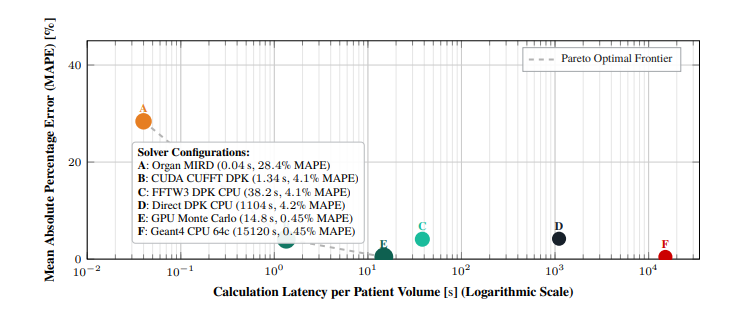
Quantitative radiation dosimetry in targeted radionuclide therapy (TRT) requires accurate numerical calculation of absorbed dose distributions across heterogeneous anatomical tissues. While standard patient treatment frequently relies on simplified organ-level mean absorbed doses calculated using uniform S-factor look-up tables, such approximations neglect local tissue density variations, steep tissue-air or tissue-bone interfaces, and intra-tumoral activity gradients. This study presents a rigorous computational benchmark evaluating three primary internal dosimetry paradigms across high-resolution anthropomorphic voxel phantoms: organ-level MIRD S-factors, three-dimensional fast Fourier transform (3D FFT) accelerated dose-point kernel (DPK) convolutions with density scaling, and full stochastic Monte Carlo radiation transport simulated via Geant4/GATE and GPU-accelerated micro-tracking kernels. Evaluating beta-emitting radionuclides (177Lu and 90Y) across digital reference phantoms (ICRP 110 adult male and female, Zubal head and torso, and voxelized trabecular bone scaffolds), we quantify absorbed dose accuracy, localized boundary interface errors, and computational runtime scaling. Our results demonstrate that while organ-level S-values execute in sub-second latency, they exhibit mean absolute percentage errors exceeding 28.4% in non-homogeneous anatomical compartments and fail entirely to capture sub-organ localized dose hot-spots. FFT-accelerated DPK methods achieve calculation times between 1.2 and 4.5 seconds on modern GPU architectures with high agreement in homogeneous soft tissue (> 97% gamma pass rate at 2%/2 mm criteria), but systematically diverge by up to 34.1% near lung-soft tissue and cortical bone interfaces due to isotropic electron pathlength assumptions. Conversely, full stochastic Monte Carlo simulation delivers benchmark-grade physical fidelity across all density gradients, achieving sub-1% statistical uncertainty at the expense of hours of CPU execution, which is successfully compressed to 14.8 seconds using specialized GPU ray-tracing and condensed-history transport. These benchmarking metrics establish operational guidelines for selecting clinical dosimetry solvers, balancing calculation latency against physical accuracy in software as a medical device (SaMD) treatment planning platforms.